Description
Scaly-Breasted Lorikeet
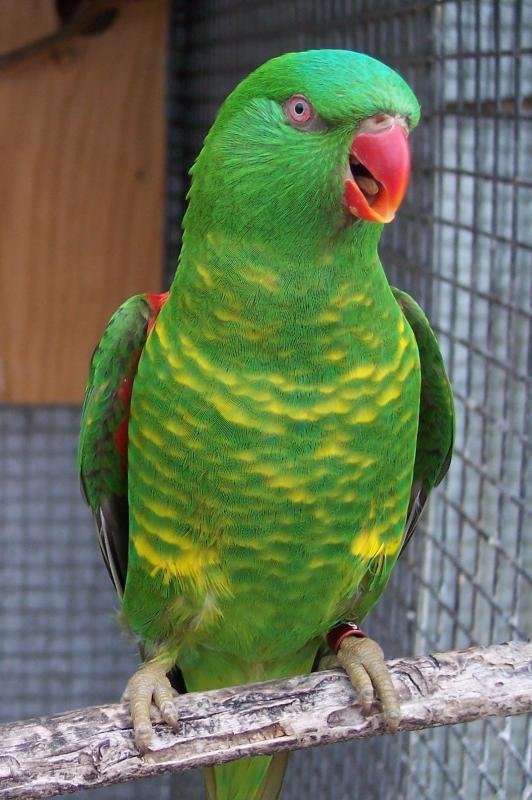
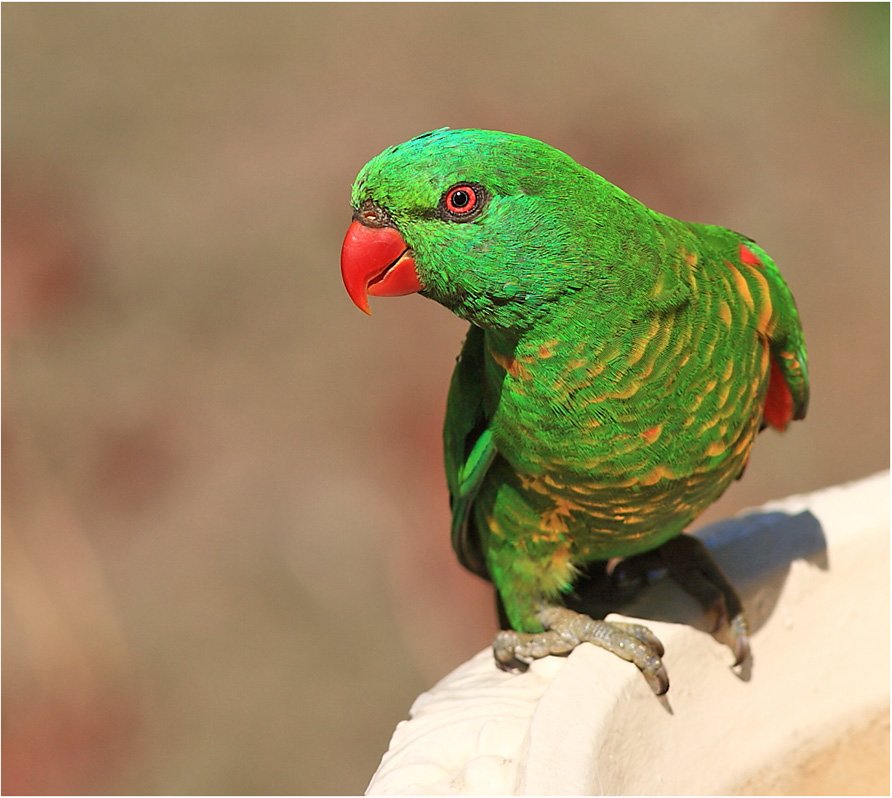
A green-and-gold flash through the eucalypts, named for the scale-like pattern brushed across its chest.
📊 Least Concern
🍯 Nectar & Pollen Feeder
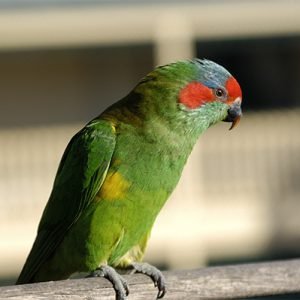
Next to the more famous Rainbow Lorikeet, the Scaly-Breasted Lorikeet is arguably the most familiar lorikeet in Australian gardens and aviaries alike. Its yellow breast feathers, each edged in green, overlap like tiny fish scales — a detail that gives the species both its name and its unmistakable texture up close.
Identification
Look for an emerald-green crown lightly tinged with blue, a scaly yellow-and-green chest, and a coral-red bill. In flight, flashes of orange-red under the wings give it away instantly, and the tail shows the same warm orange-red at its base.
Habitat and Range
This species occupies open forests, woodlands, and coastal heath along Australia’s eastern seaboard, from northern Queensland down through northeastern New South Wales. It adapts easily to urban parks and gardens too, especially wherever flowering eucalypts and melaleucas provide a steady nectar supply.
Using a specialized brush-tipped tongue, this lorikeet collects nectar and pollen while feeding, inadvertently pollinating flowering native trees as it moves between blossoms — a small bird doing real ecological work every time it eats.
Diet in the Wild and at Home
In the wild, this lorikeet feeds mainly on nectar, pollen, blossoms, and soft fruit, occasionally taking insects along the way. Because it’s a nectar specialist rather than a seed-eater like a Budgerigar, captive diets need a dedicated liquid or powdered nectar mix as the daily base, rounded out with fresh fruit, vegetables, and the occasional sprouted seed.
Breeding and Temperament
Pairs nest in tree hollows, with both birds chewing wood to shape the cavity before the female lays a small clutch of one to three eggs. Because they breed readily in captivity, either as single pairs or small colonies, they’re considered one of the easier lorikeets to keep — playful, active, and, like most lorikeets, happiest with plenty of daily interaction. For a full lineup of compatible aviary companions, our complete bird collection is worth browsing.
Buyer Questions
What makes the diet different from other parrots?
As a nectar specialist, it needs a liquid or powdered nectar mix as its dietary base, unlike seed-based parrots.
Are they easy to breed in captivity?
Yes — they breed readily in pairs or small colonies given a suitable nest box and consistent nectar-based diet.
Do they mix well with other lorikeets?
Yes — in the wild they often feed alongside Rainbow Lorikeets, and the same sociability tends to carry over into aviary settings.