

Description
Lories & Lorikeets: A Buyer’s Guide
Brush-tongued, nectar-loving, and dressed in some of the boldest colors in the parrot world.
🍯 Nectar specialists
🦜 40+ species worldwide
“Lory” and “lorikeet” get used almost interchangeably, and biologically, they’re closely related. The real difference comes down to build. Lorikeets carry a longer, more slender tail and a smaller overall frame, while lories are stockier, with a short, blunt tail that gives them a heavier silhouette in flight. It’s a subtle distinction until you see the two side by side, and then it clicks immediately.
A Color Palette Like No Other
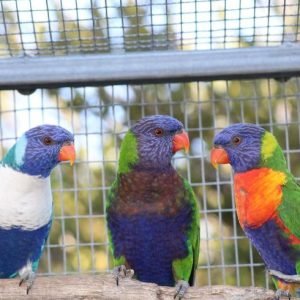
Across the group, plumage spans red, blue, yellow, green, violet, and olive-brown, often several colors on a single bird. The Rainbow Lorikeet shows this off best: a blue crown and cheeks, a greenish-yellow collar, a red chest barred with black, and yellow thighs barred with green — practically every color on the list, packed into one bird.
Lory vs. Lorikeet at a Glance
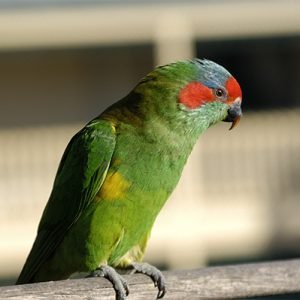
Longer, slender tail. Smaller overall body size. Example: Rainbow Lorikeet, Musk Lorikeet.
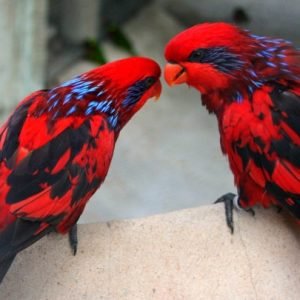
Short, blunt tail. Stockier build. Example: Collared Lory, Blue-Streaked Lory.
Telling Males From Females
Most pet lory and lorikeet species look identical regardless of sex, so DNA or surgical sexing is usually the only reliable method. A handful of species break that pattern, though. In the Fairy Lorikeet, for example, females show yellow patches along the sides of the rump, while males carry bright yellow on the underside of the tail instead — a small but genuine visual clue in a group where most species give nothing away.
Because lories and lorikeets feed mainly on nectar and pollen, their droppings run much wetter than a seed-eating parrot’s. That’s worth planning for in aviary design, and it’s part of why keepers often choose our Scaly-Breasted Lorikeet and similar species for dedicated outdoor setups rather than indoor cages.
Buyer Questions
Are lories and lorikeets the same bird?
They’re closely related but not identical — the main difference is tail length and body build, with lorikeets being slimmer and longer-tailed.
Can I tell males and females apart by looking at them?
Usually not — most species are visually identical between sexes, though a few, like the Fairy Lorikeet, show subtle color differences.
Why do their droppings need special attention?
Their nectar-based diet produces much wetter droppings than a typical parrot, so aviary setups need to account for that in cleaning and design.