

Description
| Size | Around 31cm (12in), including tail |
| Weight | 145–155g |
| Native Range | Tanimbar Islands & Babar, Indonesia |
| Conservation | Near Threatened (IUCN), CITES Appendix II |
| Sexes | Monomorphic — males and females look alike |
Identification
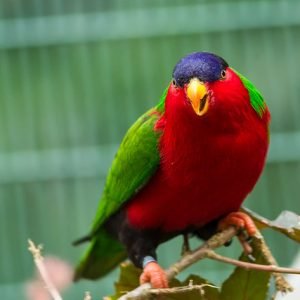
The body is mostly scarlet red, set off by a violet-blue band running from the eye across the ear coverts to the neck, and streaks of metallic blue across the nape and upper back. The wings carry red feathers tipped in black, the tail runs almost black, and the beak is a bold orange-red. Unlike many lory species, males and females are visually identical, so confirming sex reliably requires DNA testing rather than plumage alone.
Range and Habitat
This lory is endemic to a small pocket of Indonesia — the Tanimbar Islands and Babar in the southern Moluccas — and doesn’t occur naturally anywhere else on Earth. It moves between coastal mangroves, coconut groves, plantations, and both secondary and primary forest, feeding on nectar, pollen, and soft fruit as it goes. Its narrow native range is part of why it’s classified Near Threatened, and it plays a similar ecological role to the Musk Lorikeet, moving with the bloom of flowering and fruiting trees.
Restricted-range species: historically heavy trapping pressure means captive-bred Blue-Streaked Lories are genuinely uncommon — this isn’t a bird you’ll find on every aviary list.
Diet and Care
As a nectar and pollen feeder, this lory needs a specialized liquid or powdered lory nectar mix as the base of its diet, supplemented with fresh fruit, buds, and the occasional seed. It’s an energetic, vocal bird that does best with daily interaction and a spacious enclosure — standard seed-only diets are not suitable for this species.