

Description
Lilian’s Lovebird Appearance
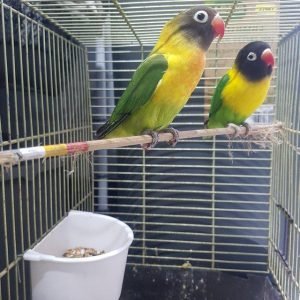
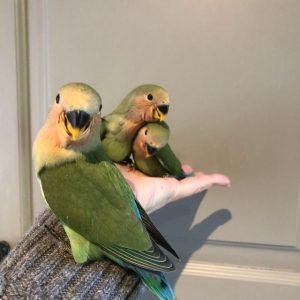
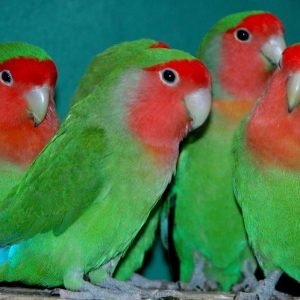
The forehead, throat, and upper face show warm orange-red coloring.
Green covers most of the body, including the rump and tail.
A noticeable pale eye ring surrounds the dark reddish-brown eye.
Natural Habitat
Lilian’s Lovebirds are associated with mopane and Acacia woodland,
riparian fig forests, and river valleys across parts of southern Africa.
They have a strong association with surface water.
Social Behavior
These lovebirds are highly social and may gather in flocks of 20–100
birds or more when food is plentiful. They also form communal roosts
in tree hollows.
Diet & Feeding
Wild Lilian’s Lovebirds feed on grass seeds, millet, wild rice, flowers,
fruits, and leaf buds. For companion birds, provide a varied and balanced
diet with suitable formulated food, fresh plant foods, and clean water.
Provide secure housing with enough room for active flight and movement.
Offer safe branches, chew toys, perches, and regular enrichment.
These birds enjoy bathing, so provide a safe shallow bath or misting option.
Breeding & Nesting
Lilian’s Lovebirds build roofed nests in crevices, particularly in mopane trees.
A clutch can contain 3–8 eggs, while young birds fledge at around 35 days.
Captive breeding requires suitable nesting facilities and careful management.
Conservation Note
Lilian’s Lovebird is classified as Near Threatened.
Habitat loss, capture for trade, persecution, and poisoning of waterholes
are among the documented threats. Responsible captive sourcing and avoiding
wild-caught birds are therefore especially important.
Explore more birds in our
complete bird collection
or discover our
Rainbow Lorikeet
.
Nyasa Lovebirds FAQ
What is a Nyasa Lovebird?
Nyasa Lovebird is another common name for Lilian’s Lovebird,
scientifically known as Agapornis lilianae.
How big is a Lilian’s Lovebird?
The World Parrot Trust lists Lilian’s Lovebird at about 13.5 cm long
and 28–37 grams in weight.
What do Nyasa Lovebirds eat?
Their natural foods include grass seeds, millet, wild rice, flowers,
fruits, and leaf buds. Captive birds need a varied, balanced diet.
Are Lilian’s Lovebirds social?
Yes. They are highly social birds that can gather in large flocks,
especially where food and water are available.
Are Lilian’s Lovebirds rare in captivity?
The World Parrot Trust describes their captive status as rare.
Captive breeding can also be challenging.
Where can I find Nyasa Lovebirds for sale?
When searching for Nyasa Lovebirds for sale, check health records,
captive-bred documentation, age, diet, and legal sourcing information
before purchasing.